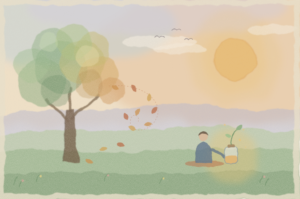


It is three in the morning, and you are awake. Nothing is wrong, exactly. The bills are paid, the people you love are asleep, and the day’s work is done. Yet a question sits on your chest: What have I actually done with my life? It does not ask about your job title or your bank balance. It asks about something quieter that you cannot point to, and for which you have no receipt.
Many of us meet this question for the first time in middle age, and more often as the years go by. It carries a particular kind of fear: that time is running out, and that the part of us that matters most has been left unattended.
The only audit that matters is invisible
Almost everything else in life is measured by someone. Your work is reviewed, your income is counted, your appearance is judged, and your achievements are compared to those of others. These measurements are loud, public, and constant, and over time we begin to confuse them with our worth.
The soul has no such scoreboard. Nobody can see how honest you have been with yourself, how much you have forgiven, how deeply you have learned to love, or how calmly you now meet what once undid you. There is no report, no ranking, and no audience. It is a ledger written in invisible ink, and the only one who can read it is you.
This is both a relief and a responsibility. It is a relief because no one else’s opinion can raise or lower the real balance. It is a responsibility because no one else will notice if it is neglected. A person can look accomplished from every outside angle and be starving within, and a person who looks ordinary can be quietly rich.
Why the night is when it speaks
During the day we keep the question away with activity. Noise, tasks, and talk fill the space where it might arise. At night, when the distractions fall silent, the ledger opens by itself, and we feel its balance whether we want to or not.
This is why so many people sleep poorly in later life, and why the fear gets sharper as the calendar turns. The mind starts to do arithmetic: how many years remain, what is still undone, what can no longer be undone. The fear is understandable. It is also, to a large degree, a signal that something inside is asking for attention and has been waiting a long time.
Sleep that comes easily is rarely the reward of having everything finished. More often it belongs to people who have made some peace with themselves, who go to bed with their inner account roughly in order. You don’t need a perfect record. You need to know that you are tending it.
Words are not enough
Most of us say the right things. We tell ourselves we should be more present, meditate more, forgive that person, simplify, slow down. We read about it and talk about it, and some of us write about it. But a wish repeated is not a practice, and the soul does not grow by being discussed.
It grows through action, small and repeated and chosen on purpose. A conscious effort made after the day’s responsibilities are done, not in place of them, is what counts. The point is not to run away from duty. Work, family, and care for others are real and honorable. But when the duties of the day are complete, there is usually a pocket of time, perhaps a half hour, that drifts into scrolling, noise, and idle chatter. That pocket is where the soul’s work can quietly happen.
What the effort looks like
Consider three simple habits, all within reach of an ordinary, busy life.
1. Give the soul goals, just as you give goals to everything else.
We set targets for fitness, income, and career, and leave the inner life to chance. Try naming a few soul-level aims, such as to be more patient with my family this month, to read one teaching slowly, or to let go of one old resentment. Keep them small and specific. Review them gently, the way you would check any plan, with curiosity and not with judgment.
2. Choose solitude on purpose.
Not loneliness, which is solitude imposed, but a chosen stillness. Set aside a regular window, even twenty minutes, with no phone, no screen, and no one to perform for. Sit, walk slowly, or simply be in a quiet room. It will feel awkward at first, and the mind will protest. That protest fades.
3. Practice contemplation, not just thinking.
Thinking solves problems. Contemplation lets a single question or teaching settle through you. Take one line, such as what am I holding that I could put down?, and rest with it without forcing an answer. Let it sink beneath the surface, as in the seed that ripens underground.
Pulling the mind back from the noise
Here is the quiet heart of it: the mind, left alone, drifts outward, into the opinions of strangers, the chatter of the feed, and the churn of the news. Each of these feels like attention, but much of it is idle. It takes energy and gives back little, and it leaves little room for the voice that matters most.
The practice is to retract, gently and repeatedly, like a tortoise drawing its limbs inward. When you notice the mind running outward, you don’t scold it. You turn it back toward the breath, the body, and the quiet center. At first this takes effort. With time, it becomes a place you can go and feel at home, with calm and peace that don’t depend on anything outside.
The witness and the fear of time
This is where Turiya becomes more than an idea. The witness is the part of you that has watched every year of your life go by and has not aged. It was there when you were ten and it is here now, untouched by the count of the calendar. From that seat, the fear of running out of time looks different. It is a thought, a real and understandable one, arising in a mind that is itself passing, while what watches does not pass.
That does not make the years unimportant. It means the deepest part of you is not racing the clock. And when you rest there, even briefly, the three o’clock question softens. You are no longer an accountant frantically adding up what is missing. You are a witness, and what you are witnessing is a life that is still unfolding.
A word of balance
Don’t turn soul-work into one more list on which to fail. If it becomes another source of pressure, it has missed its purpose. Some days, solitude will be restless and contemplation will feel like nothing at all. That is normal, and the benefit often shows later, in how you respond to small things.
Also be honest about the practical side. If sleeplessness, dread, or low mood are heavy and persistent, speak to a doctor or counselor. The inner path and good care of the body and mind work together, and seeking help is a form of tending the soul, not a departure from it.
An invitation
This week, choose one pocket of time after your duties are done. Protect it as you would an appointment with someone you love. Put the phone in another room.
For the first ten minutes, simply sit and let the mind settle. Then ask one quiet question: What does my soul need from me this week? Don’t hurry the answer. Write down whatever comes, even if it is only one word.
Then do one small thing about it before the week ends. Make the call, read the page, forgive the slight, or take the walk.
That is all. You are not trying to settle the whole ledger tonight. You are simply opening it, in daylight, and writing one honest line.
Do that often enough, and the three o’clock question changes its tone. It stops sounding like an alarm and begins to sound like a quiet invitation, one you have been answering, little by little, all along.