

It is a quiet evening, and a message lights up your phone. Someone you know has been promoted, bought the house, or launched the thing, and the post is full of exclamation points. A few comments down, someone suggests, kindly or not, that you could be doing more, that you’re too slow, too careful, not hungry enough. You type a reply. You delete it. You type another one, sharper, and delete that too. Then you put the phone down, and the old question settles in: Am I falling behind, or am I just walking a different road?
That question is where the high road begins. It rarely starts with a grand decision. It starts with a small, unwitnessed moment of choosing not to react.
The high road is not scenic
We talk about the high road as if it had good views and good company. Mostly it is steep, quiet, and uphill. It means swallowing the clever reply, skipping the argument you would win, and letting a slight pass without correcting the record. It means lowering your ego while the ego is loudly asking for credit.
Nobody applauds these choices, because from the outside they look like nothing. A person who doesn’t retaliate looks the same as a person who didn’t notice. That is part of the cost, and the work happens anyway.
The pressure of other people’s success
Watching others win loudly is one of the sharpest tests there is. The gloating may be open or it may be polite, but the implied message is the same: this is the pace, this is the prize, and you are behind on both.
Sometimes it is said outright. You are told you aren’t enterprising enough, ambitious enough, or hungry in the way they define hunger. It stings, and it is fine to admit that. But before you respond, a few questions are worth asking:
- Whose ruler am I being measured against?
- Did I ever agree to compete in this particular race?
- Is this person describing me, or describing the script they are following?
- Would I want what they have if no one could ever see it?
Being insulted for not following someone else’s script says more about the script than about you.
Going against the curve
The world has a strong pull toward what is visible, fast, and easy to compare. It rewards display over depth and speed over substance. If you choose patience over performance or character over image, you will stand out, and not always flatteringly. People may call you slow, naive, or strange, because anyone who steps out of the game quietly reminds them that stepping out is possible.
Going against the curve means accepting being misunderstood for a season. The gap between who you are becoming and what others can see will feel wide. That gap is uncomfortable, but it is where most of the real work gets done.
Keep the inner and the outer apart, until they are ready
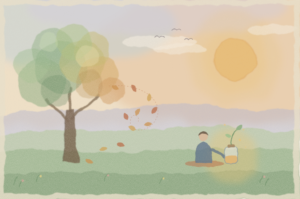
Here is the idea that has helped most. Your inner life, with its questions, convictions, and slow rebuilding, doesn’t have to be on display while it is still forming. A seed isn’t shown to a crowd on the day it is planted. Your outer life, with its work, conversations, and obligations, can carry on without explaining everything happening underneath.
This is not secrecy for its own sake, and it is not deception. It is protection. Each side gets room to grow without being pulled apart by other people’s opinions, which tend to arrive long before the thing is strong enough to hear them.
Then bring them together on a single plane
The goal is not to stay divided forever. At some point you gather the depth and the courage to see everything on a single plane: what you think, what you value, what you do, and what your circumstances actually are, all in the same light, with nothing hidden from yourself.
That is the moment the two sides unite. And once you can see it all at once, you can act on it without the gap between what you believe and how you live. The action may be small, such as a conversation you finally have, a path you finally choose, or a thing you finally stop doing. But it comes from one piece, and people can feel the difference.
It takes the time it takes
This rarely happens quickly. It builds through small private decisions, reflections nobody sees, and years of choosing the harder option when no one is looking. Some days it feels like progress, and others it feels like standing still.
Impatience is the enemy here. The urge to hurry, announce, and prove comes from the same ego you are trying to quiet. The work will be ready when it is ready, and not before.
The right audience
Building yourself doesn’t need an announcement. Not every effort deserves an audience, and not every audience deserves the effort. A useful filter:
- Does this person understand quiet work, or only visible results?
- Do they ask questions, or hand out verdicts?
- Do I feel steadier or shakier after talking with them?
- Would they still respect this if it never succeeded?
Share the work with the one or two people who pass those tests, and let the rest of the world meet the results in time. Character is best shown, not declared.
The witness in the noise
This is where Turiya becomes practical. In the Vedantic tradition, Turiya is the “fourth” state, the awareness that quietly watches waking, dreaming, and deep sleep without being any of them. You don’t need to reach it fully to borrow its gift. The witness is the part of you that can watch the sting, the comparison, and the urge to prove yourself, without being swept away by them.
From that seat, the thoughts change shape. I feel behind. I feel the heat of that comment. I feel the pull to answer. These stop being verdicts and become weather, passing movements in the mind that you can notice without obeying. That small distance is what makes the high road walkable. Without it, every gloating post feels like a ruling on your worth, and lowering your ego feels like being erased. With it, you can feel the sting fully, let it pass, and still choose your next step calmly.
The witness is also what makes the union possible. It is the vantage point from which the inner and outer can be seen on a single plane, because it isn’t tangled in either. You don’t have to force it, and you can’t rush it. You practice it in small ways: a breath before replying, a few quiet minutes at the end of the day, and the simple habit of saying to yourself, I notice I’m feeling this, instead of I am this.
A word of balance
The quiet road is not a license to feel superior. Silence can become contempt, and privacy can slide into isolation. Some of the people who criticize you are right about something, and it is worth sorting that out from the noise instead of dismissing all of it. Being misunderstood is not proof you are right.
Be careful, too, that “inner work” doesn’t become a place to hide. If it never touches the outside, it isn’t finished. The point of building the self in private is to eventually act in public, with integrity, when the time is ready.
An invitation
Tonight, before you reply to anything or compare anything, take a sheet of paper and answer five questions:
- What am I building that doesn’t need an audience yet?
- Whose approval am I still performing for?
- When I feel the sting of comparison, can I name it from a step back? (“I notice I’m feeling behind.”)
- Who are the one or two people who would understand this without it being explained?
- What is the smallest quiet action I can take tomorrow that matches what I actually believe?
Then put the pen down and take that step, without telling anyone. Let it be enough for now.
You don’t need to win the argument, match the pace, or be seen. You need to keep building. The seed doesn’t announce itself, and when the roots are deep enough, the tree won’t need to either.